


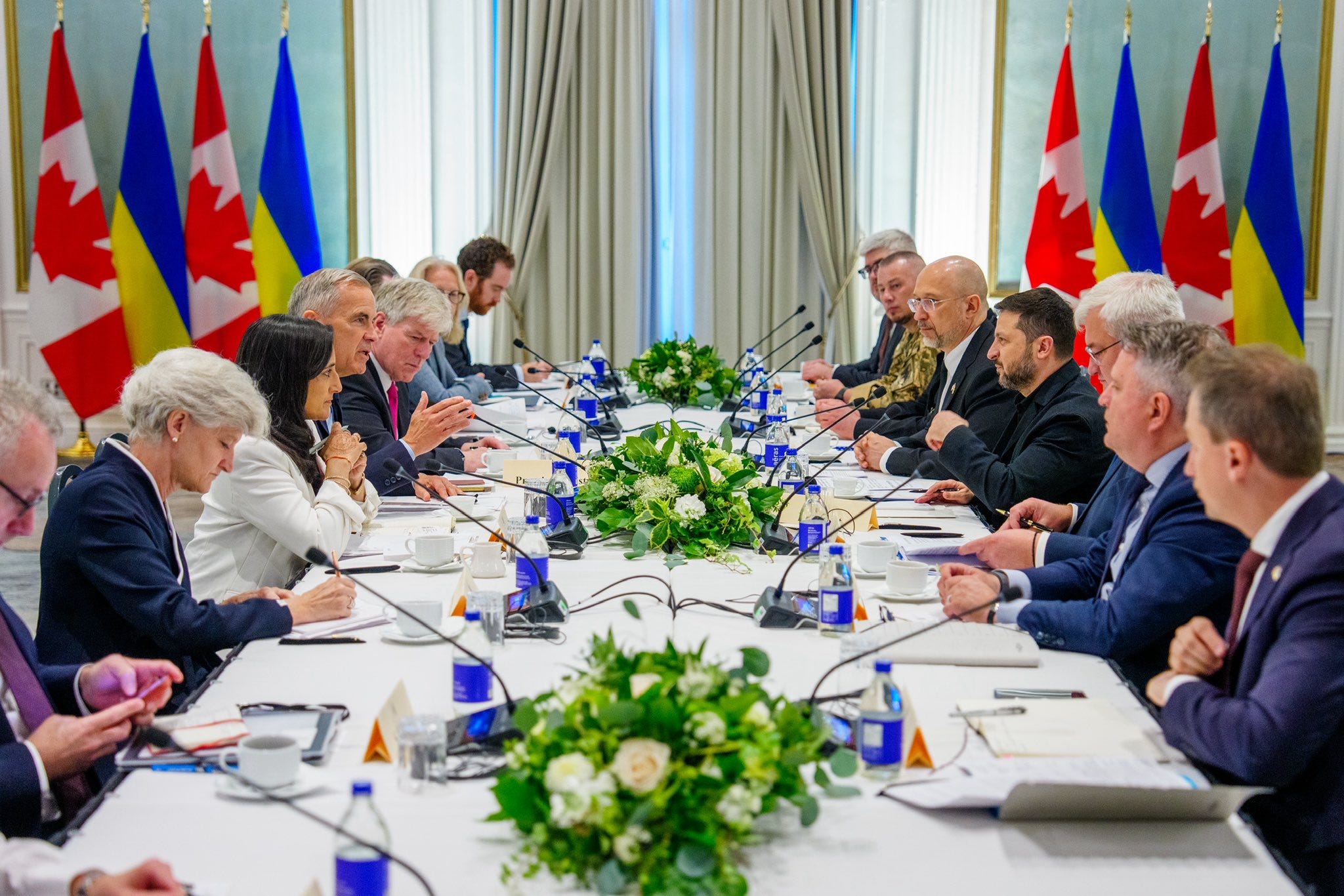
Canada and Ukraine signed a broad package of agreements Thursday that reshape relationships around defence production, reconstruction, energy security and critical minerals.
Prime Minister Mark Carney and President Volodymyr Zelenskyy announced the arrangement, including a declaration for a 100-yr partnership, a $350M air-defence package for Ukraine and a plan to expand Canadian drone production.


The agreement is a shift from traditional military aid toward a longer-term Canada-Ukraine defence-industrial partnership.
Canada will draw on Ukraine’s hard-won expertise in drone operations, electronic warfare, counter-drone systems, and rapid defence innovation by collaborating on joint production of uncrewed systems, ammunition, and related capabilities.
The framework also covers R&D, testing, tech transfer, and commercialization of resulting intellectual property.
Drone marketplace, meet drone maker
PM Carney said Canada’s objective is to build capacity to manufacture millions of drones within two years, with roughly one-third allocated to Ukraine.
Ottawa is in the midst of creating a national drone marketplace for the Canadian Armed Forces and Canadian Coast Guard, with initial procurement expected to 10x Canadian military’s drone inventory.
For Canada, the industrial benefits may be as important as the security commitments, given the current criticism over limited defence-manufacturing capacity, slow procurement and insufficient access to low-cost, mass-produced military systems.
A closer relationship with Ukrainian companies could give Canadian manufacturers access to proven designs, operational feedback and a faster innovation cycle.
Hopefully Canadian SMBs will get easier pathways to market, in similar fashion to the Danish model.
The agreement could also create opportunities for Canadian firms in engineering, artificial intelligence, advanced manufacturing, cybersecurity and supply-chain development.
A partnership between General Dynamics Mission Systems-Canada and Ukrainian company Green Tech Harvest is intended to support the development and production of drones and related technologies, extending cooperation from engineering to the critical minerals and metals used in manufacturing.
The criticals
Critical minerals form a second important pillar of the arrangement. Canada and Ukraine plan to establish more secure mineral supply chains through joint research, exploration, investment and the development of new deposits.
That could serve Canada’s efforts to diversify strategic mineral supply chains, particularly as governments seek alternatives to concentrated sources of supply. Ukraine, meanwhile, could benefit from Canadian expertise in geology, project development, environmental governance and resource finance.
The immediate security commitments remain substantial.
Air Defence & Reconstruction
Canada will provide $350M for Ukrainian air-defence interceptors through the U.S.-led purchasing mechanism and nearly $435M in loan guarantees through the European Bank for Reconstruction and Development to support Ukraine’s energy security, particularly during the winter.
Canada has additionally committed $200M in concessional financing through Export Development Canada for reconstruction projects, while adding $10M to the Ukraine Energy Support Fund. Canada’s Defence and Resiliency Bank is also in the mix.
The 100-yr implementation challenge.
The 100 year declaration is a strategic framework rather than a fully specified treaty, and the promised industrial expansion will require procurement reform, private investment, skilled labour and reliable financing.
The deal offers Canada a practical opportunity to strengthen its defence industry, develop domestic drone capacity, secure access to critical minerals and position Canada for Ukraine’s eventual reconstruction.
With over 100 years of strong relations and and one of Canada’s largest diasporas, Canada & Ukraine now have a framework for the next 100.
P.S. A “hundred-year partnership” is a bold new twist for a defence drone initiative that is 6 weeks old. But since canadaxeurope got to 1,600 subscribers, anything is possible.
We must never allow other countries to censor who choose to partner with again.
We should have learned that lesson in school.
Sadly, Canadas conservative party did not.