


Canada has been selected to headquarter the multinational Defence, Security and Resilience Bank (DSRB), a multilateral institution focused on financing defence, security, and resilience projects for NATO members and allied nations.
Last week Canada was selected as the DSRB host country, an important first step in setting up the new institution. The move is projected to create 3500 jobs in defence, finance, and beyond. The bank’s charter, treaties, and first CEO have yet to be released.
What the DSRB is
The DSRB is modelled on the World Bank. Member governments contribute capital and the bank issues bonds on international markets and lends the proceeds to participating countries at rates lower than most could secure independently. The institution is designed to finance defence procurement, industrial expansion, and infrastructure resilience at the scale that commercial markets are not built to supply.
Here’s what’s next
The contest to host the new DSRB is now in the final innings. What started as a 3-way competition between cities in the Eastern time zone has grown to include Canadian defence hubs from coast-to-coast.
Montreal, Ottawa-Gatineau, and Toronto were already in the running, and now Halifax and Vancouver are the latest to enter the arena. With 5 cities now looking to host the DSRB, the bank’s clout has grown from the new North Atlantic Bank you never heard of to the next North Star of Canada’s defence industry.
Both defence and banking are cool again.
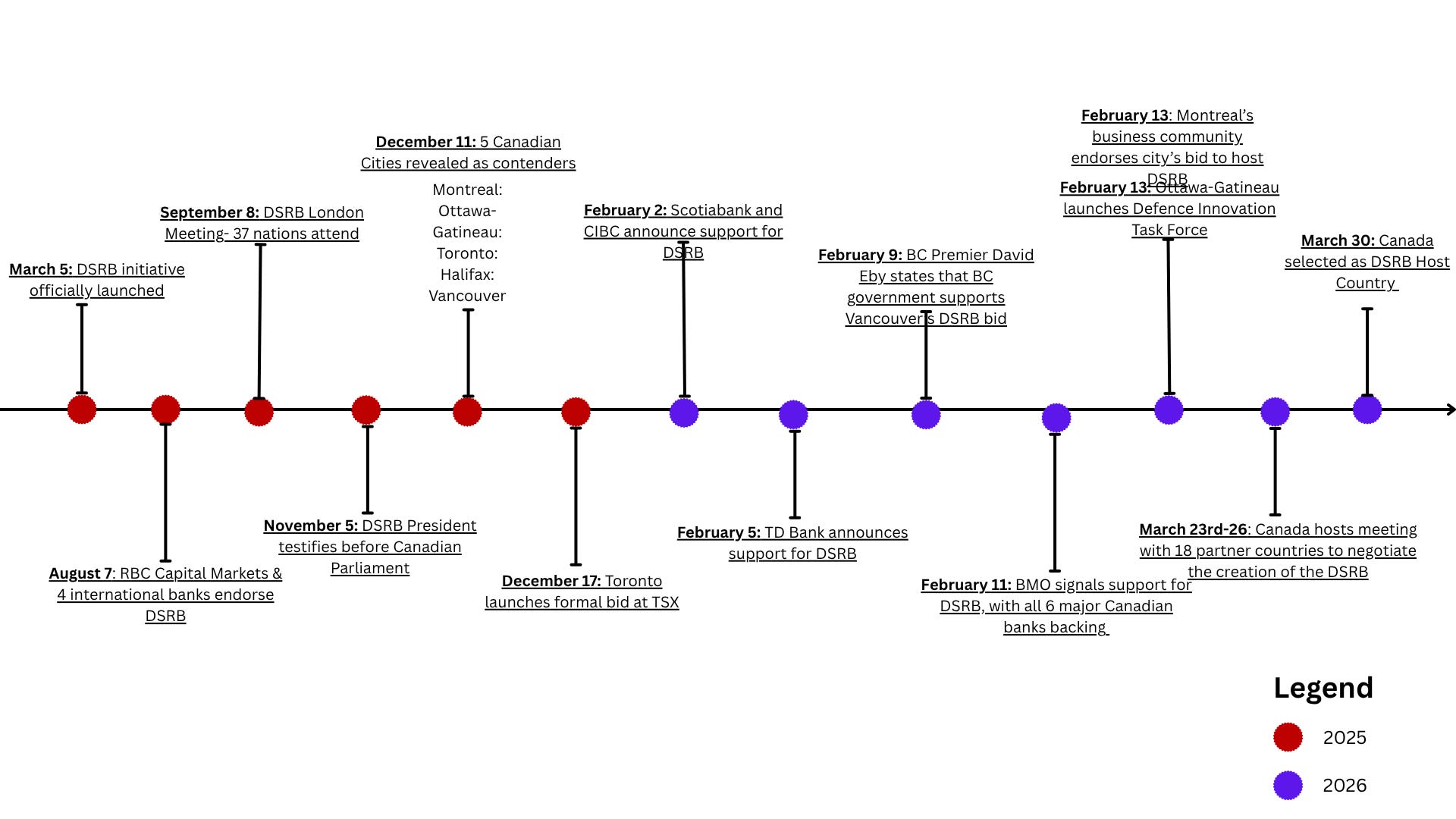
For a clickable version: https://canva.link/733yj1pxkftgq5l
From the “Battle of the Laurentians” to full-fledged regionalism
The 3 original bidding cities were all located along Central Canada’s St. Lawrence watershed, keeping the competition along the Quebec - Windsor corridor. Now that Halifax and Vancouver are in the running, challenging the Laurentian Consensus.
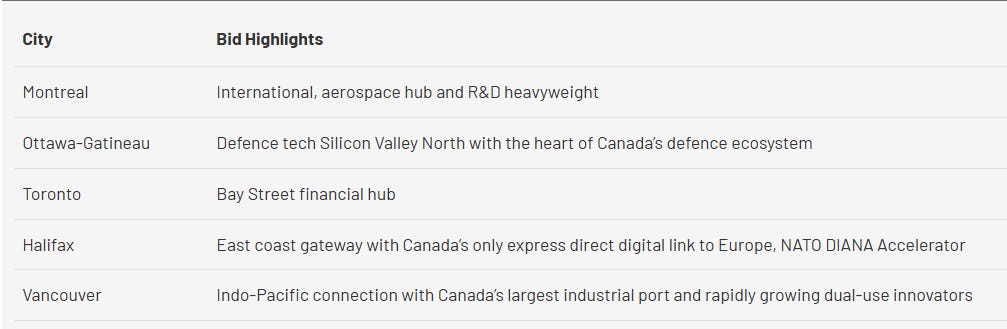
Each city’s bid highlights its defence and industrial strengths; however, the 2 coastal cities have underlined an asset that Central Canada can’t claim: industrialized & internationally connected ports.
Halifax is distinguishing itself through its maritime edge: the country’s largest naval base, the NATO DIANA HQ and COVE accelerator, and Canada’s only direct express digital link to Europe - the EXA Express transatlantic subsea fibre cable.
Meanwhile, Vancouver is leveraging its Indo-Pacific connection through Canada’s largest industrial port and its cyber, quantum, and AI tech base. Special focus is being centred on its dual-use innovators, such as Photonic, AbCellera and Sanctuary AI.
The 2 coastal cities’ bids join Montreal, focusing on its aerospace and R&D hub, the National Capital Region and its defence and innovation ecosystem, and Toronto, underlining its financial sector.
With several of the cities’ bids backed by their provincial governments, the contest to host the DSRB has grown from a battle between cities into an inter-Canadian regional competition.
What’s to Gain from the HQ & Impact for Industry
The benefits of hosting the DSRB are an open secret: securing the bank’s HQ will give the chosen city a home-court advantage in securing financing for its domestic defence industry. Nevertheless, the strategic implications will vary between regions.
Toronto is a prime candidate for maximizing the DSRB’s financial firepower. The city is North America’s second-largest financial services hub and home to Canada’s largest banks. The latest news of Canada’s Big Six banks being on board to support the DSRB, combined with a sophisticated financial workforce, makes Ontario’s capital a strong contender.
For Canadian defence primes, this also means faster, cheaper access to project financing (a chronic bottleneck in domestic procurement as the government pays by milestones cash flow challenges).
From a government integration standpoint, Ottawa-Gatineau make a compelling case for the HQ. With hundreds of defence firms already operating in the capital region, placing the DSRB alongside the new Defence Investment Agency would create a strong nexus of procurement, finance, and industrial policy.
Montreal’s aerospace and research base would receive a notable boost from having the DSRB to tap into, especially given the possibility of using the financing for dual-use tech and advanced manufacturing. The region credits itself with the lion’s share of defence contracts.
From a geopolitical perspective, Vancouver offers a unique option given its proximity to Indo-Pacific partners. Beyond that, its industry’s specializations in cybersecurity, AI, and marine tech provide niche financing opportunities.
Halifax represents a potential dark horse. Its extensive naval infrastructure and location on the Atlantic, facing the other DSRB participating states, underscore its relevance to maritime security financing.

The political temptation is real
Canada has a long history of distributing federal institutions across cities to manage regional politics - the mint in Ottawa and Winnipeg, the CBC spread across the country and federal departments parcelled. With five cities actively lobbying, the Prime Minister will face pressure to spread the spoils.
The practical case against splitting
The Ottawa-Gatineau camp made this point directly: multilateral financial institutions are purposely located close to the clients they serve: the World Bank and IMF were both established in Washington, not New York.
Regardless of who wins, Canada’s hosting of the DSRB is a boost to transatlantic relations.
In the meantime, may the best city (and region) win.
P.S. After a short hiatus, we’re back at it.
Toronto is the only city that has the depth of expertise in the banking industry - accountants, lawyers, financial experts - to get this bank up and running in an efficient manner. The Canadian banks supporting this are headquartered in Toronto. While it is great these other cities have ports and other industries remember this is not a federal institution it is an international project and the majority of funding will be in other countries so let’s put it where the expertise is.
It won’t only be Canadians working at the bank so we also need to think about getting top notch talent other countries to locate to Canadian regional cities. They want to be where there is a network and Toronto is the only city on the list that might be mentioned as an international banking centre.
Thank you for a great article on the DSRB. Each city awaits the approval.