


First a $35B defence infrastructure investment in Canada’s North. Then a meeting with the Nordic five with deepening defence industrial cooperation ties.
What a week in Canada’s defence posture.
Let’s get started.
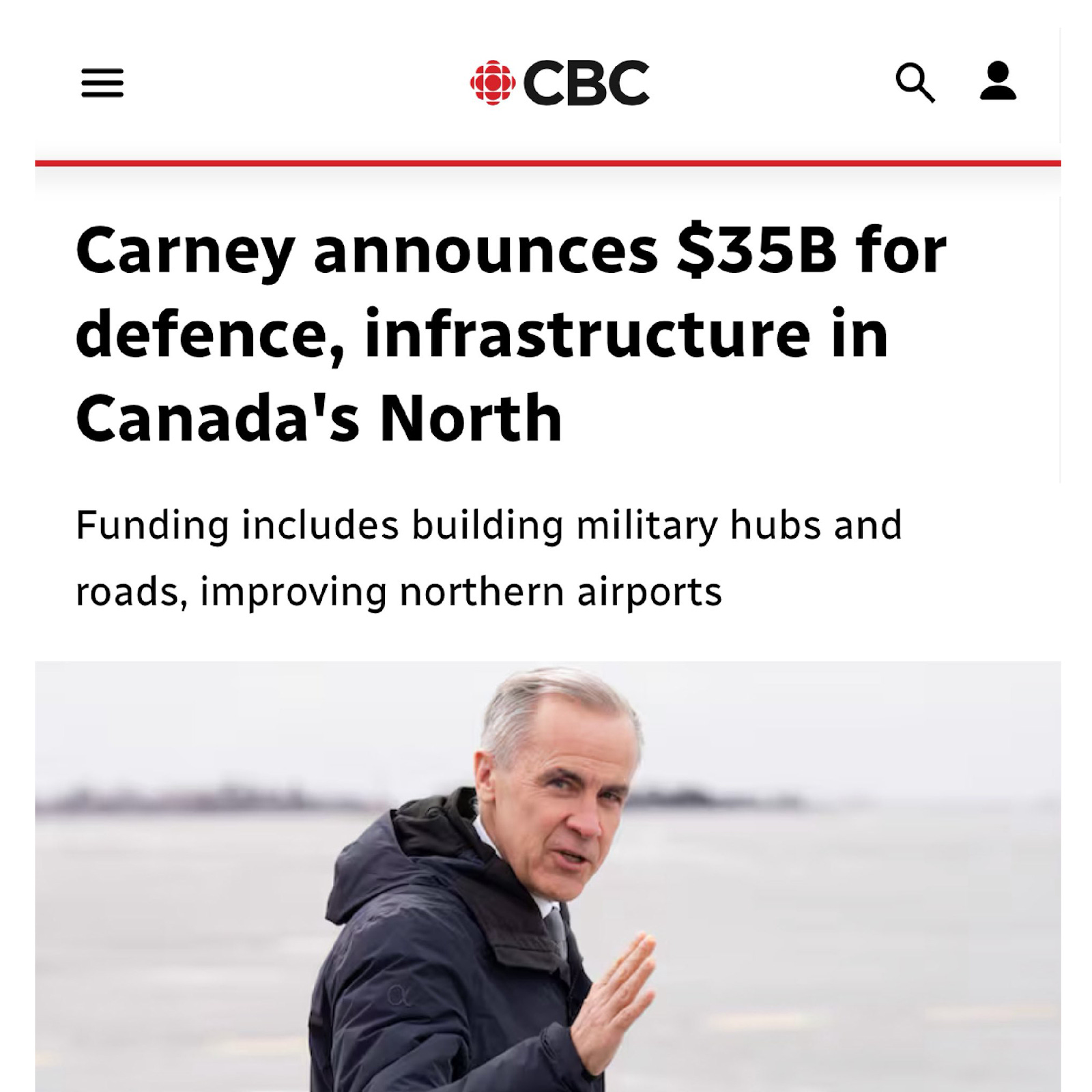
The Arctic
With this new plan, Canada is taking full responsibility for defending its Arctic sovereignty.
To defend Canada’s Arctic and North, deter new threats, and support NATO Allies and NORAD continental defence, Canada is:
Investing $32B at Forward Operating Locations in Yellowknife, Inuvik, and Iqaluit, and at Deployed Operating Base 5 Wing Goose Bay.
Includes infrastructure upgrades such as airfield upgrades; new or repurposed hangars; ammunition and fuel facilities; and buildings and equipment for accommodations, warehousing, IT.
Announcing two new Northern Operational Support Hubs (NOSHs) at Whitehorse and Resolute, and two new Northern Operational Support Nodes (NOSNs) at Cambridge Bay and Rankin Inlet, backed by an investment of $2.67B.
This network will enable the Canadian Armed Forces to deploy rapidly and support year-round response across the Arctic and North.
Investing $294M in Arctic airports, including building a runway overlay and modernising Rankin Inlet Airport and upgrading Inuvik Airport.
This will ensure larger aircraft can land, connecting Northern communities to the rest of the country year-round to enable faster, more convenient, and lower-cost travel.
Other investments include the Taltson Hydro Expansion Project, The Grays Bay Road and Port and the Arctic Economic and Security Corridor, The Mackenzie Valley Highway - bringing the total to $40-50B when non-defence investments are included.
Canada is no longer treating the Arctic as a seasonal sovereignty exercise but a permanent operational theatre requiring industrial depth and allied integration.
Arctic investment is becoming the bridge between sovereignty, industrial opportunity, and rewarding those who can operate, build, and scale in the High North.
Nordic 5
Canadian Prime Minister Mark Carney then shuffled off to Norway for a series of Arctic and Defence related meetings.
In a more dangerous, divided, and uncertain world, security can no longer be taken for granted. Canada is strengthening its defences in the North and working closely with trusted partners to protect our sovereignty and reinforce collective security.
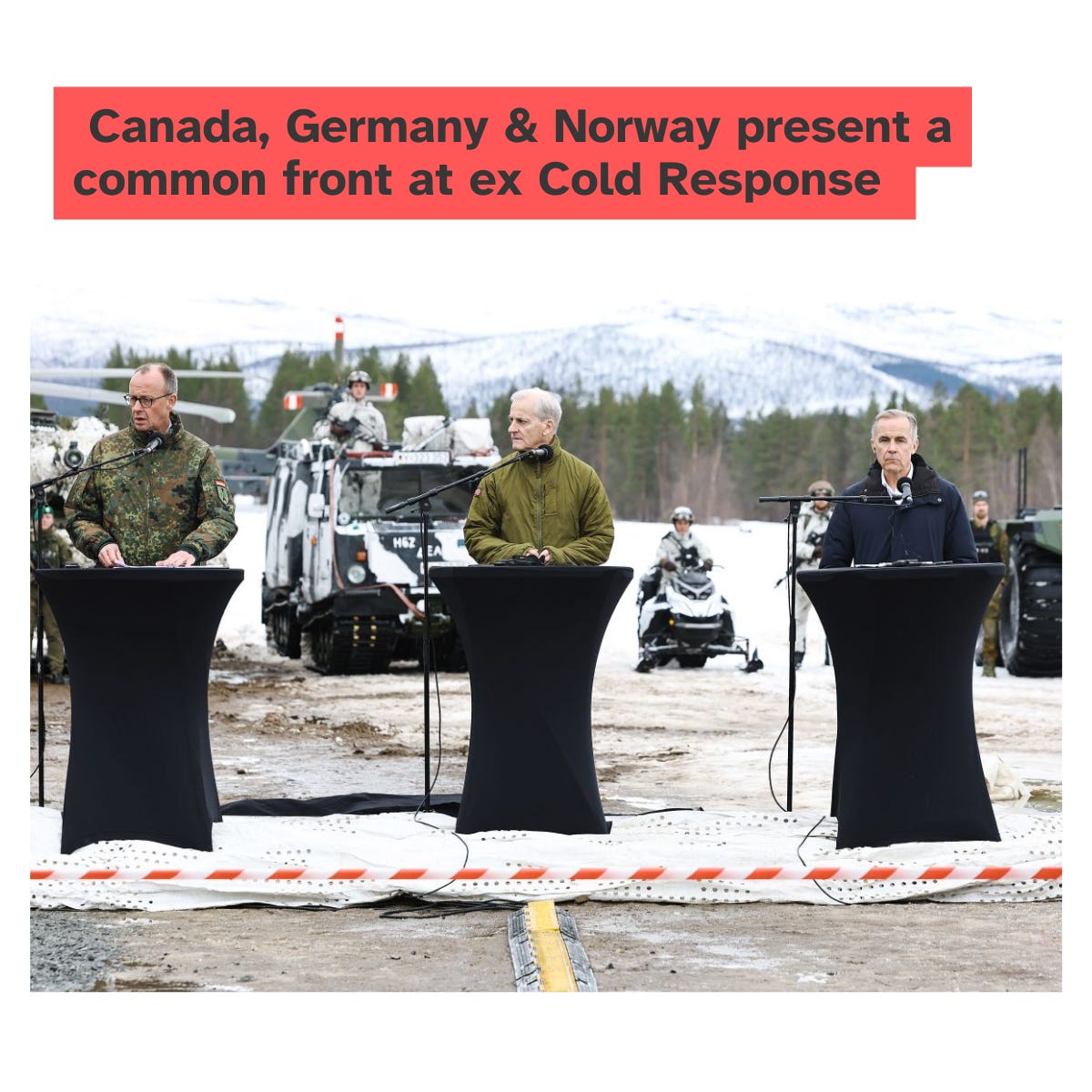
In Bardufoss, Chancellor Friedrich Merz (Germany), Prime Minister Støre (Norway) were joined by Canadian Prime Minister Mark Carney in visiting NATO exercise Cold Response, emphasizing that security in the Arctic is crucial to the security of all allies:
“We are facing the most serious security situation since World War II. It is more important than ever that we work closely with our allies on our shared security. That is why it is good to be here in Bardufoss with the German Chancellor and the Canadian Prime Minister to see how soldiers from NATO countries are training to defend Norway and the Nordic region,” - Prime Minister Jonas Gahr Støre.
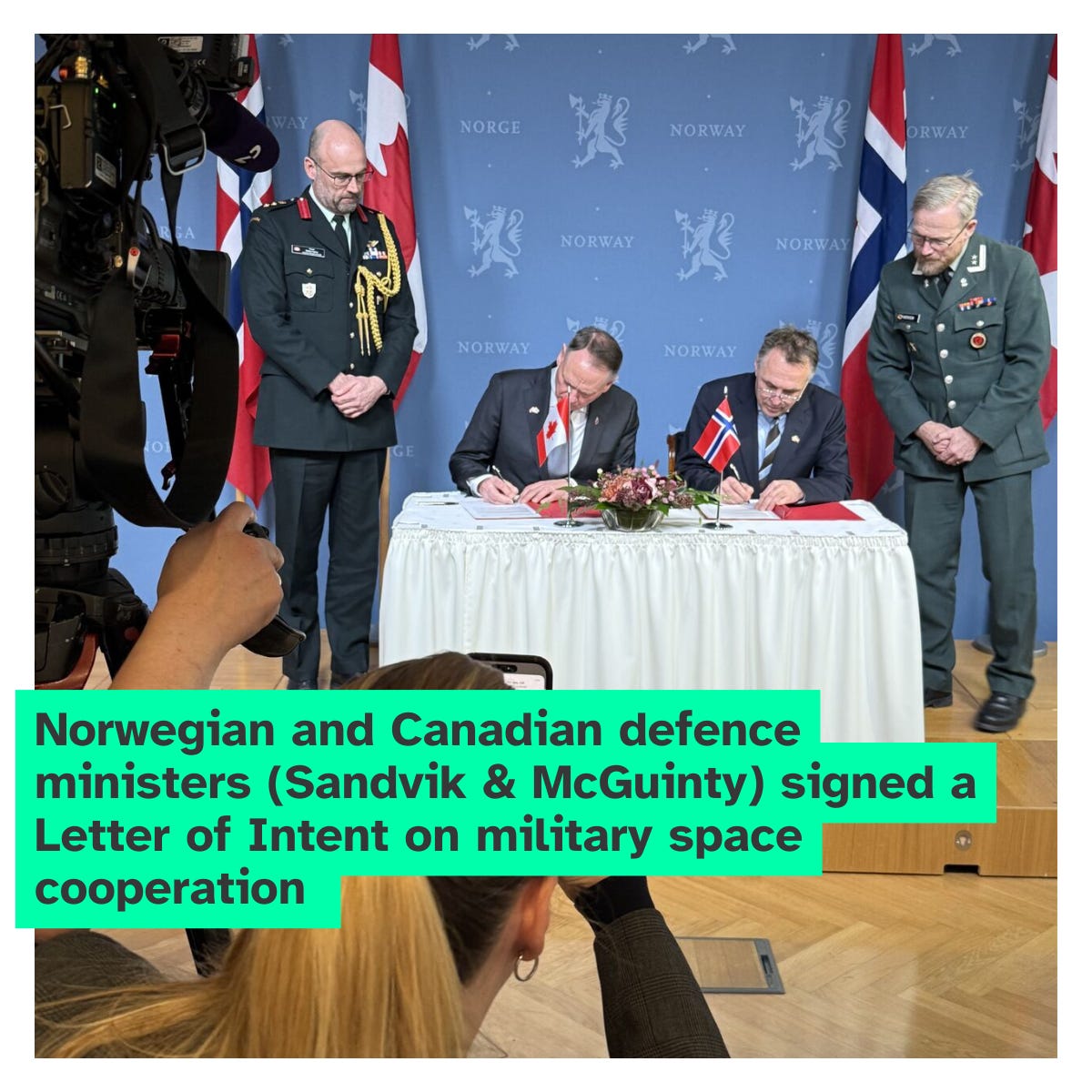
Next up Canada and Norway announced an agreement on Space cooperation in defence and security.
The Letter of Intent deepens cooperation in the space domain. As Arctic nations and Allies in NATO, Canada and Norway share a strong commitment to protecting the North and advancing collective security. By strengthening cooperation on space capabilities and innovation, they are ensuring our forces remain ready, resilient, and prepared for the challenges ahead.
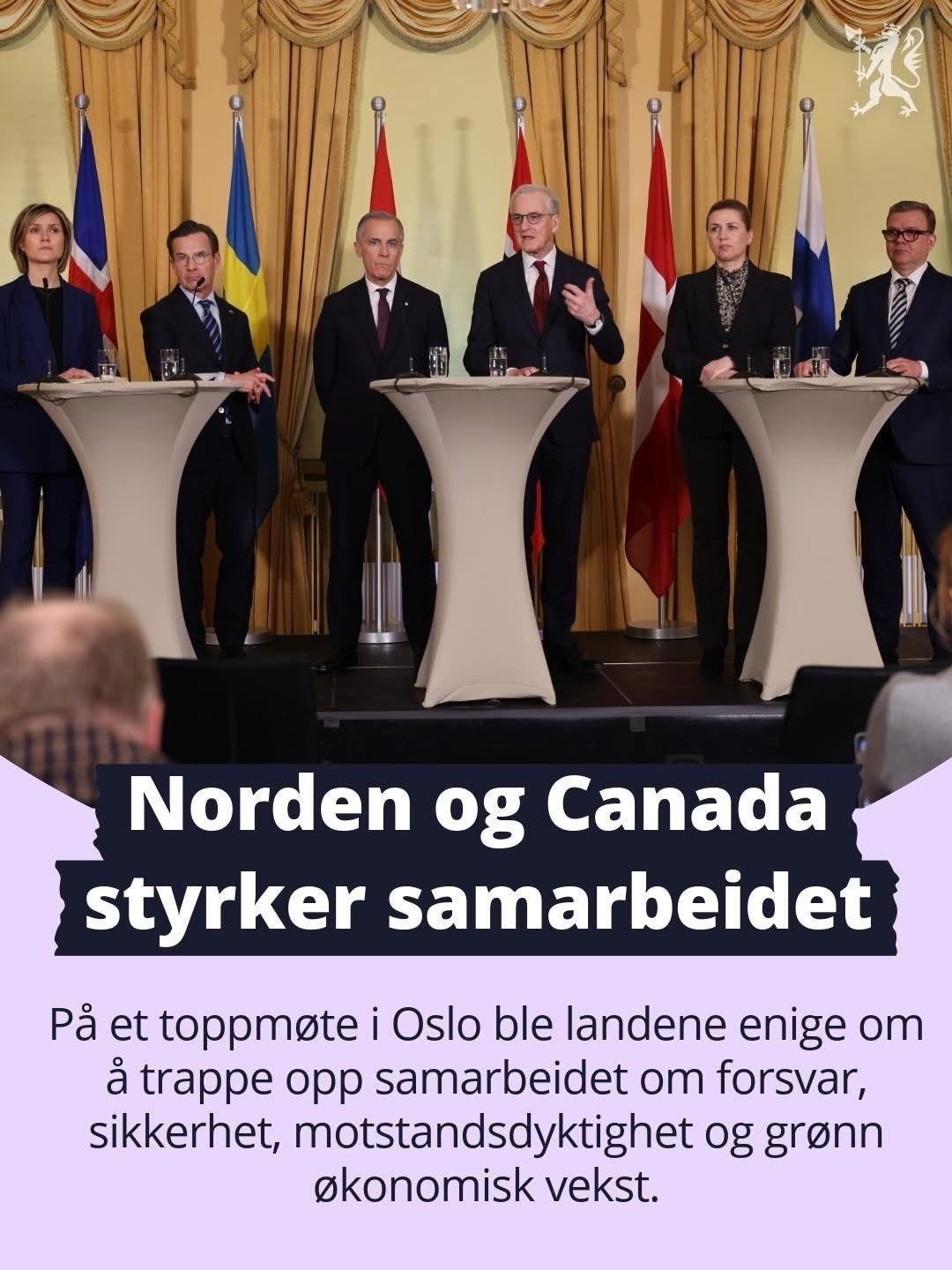
Then came a meeting with the Nordic 5 plus Canada. As Tore O. Sandvik, Norway’s Minister of Defense reminds us:
Together, Canada and the Nordic countries represent a ~$4T economic footprint - on par with the world’s largest advanced economies (Germany, Japan) - underscoring the strategic weight of closer transatlantic cooperation.
Where does this leave the new Arctic Industrial Base?
Canada’s latest Arctic posture is no longer evolving in isolation - but converging with the broader Northern European security architecture and increasingly defined by the Nordic 5: Denmark, Finland, Iceland, Norway, and Sweden.
The once loose regional grouping has, post-Ukraine, become a tightly aligned bloc at the core of NATO’s northern flank - bringing together Arctic geography, advanced defence industries, and operational experience in extreme environments.
No single country (Canada included, 70% ambitions aside) can independently build the full spectrum of Arctic-ready systems. The Nordics offer proven platforms, tested doctrine, and mature supply chains that Canada can integrate into through procurement and ITB frameworks.
In a nod to Canadian Patrol Submarine Project (CPSP), Canada’s billion-dollar submarine program, the visits receive plaudits on defence alliance-building and hopes for boats and alliances.

Canada’s renewed Arctic focus anchored in NORAD modernization, expanded surveillance, and all-domain presence is mirrored by Nordic investments in resilience, mobility, and deterrence in the High North. We might be in the early stages of a transatlantic Arctic system.
While numerous other European firms could benefit from increased cooperation across the Arctic Nammo AS, KONGSBERG, Space Norway, Andoya Space, Helsing, HENSOLDT, Isar Aerospace, Rheinmetall, OHB SE, BAE Hagglunds
Canada cited an example of growing defence industrial collaboration between Canada and Norway is a recent $9.6M contract awarded to the joint venture Kongsberg Vanguard LP - a partnership between Norwegian firms Kongsberg Defence & Aerospace and Salt Ship Design, as well as Ottawa-based Adaptive Marine Solutions. The joint venture will design the Canadian Coast Guard’s future mid-shore multi-mission vessels.
The High North Pivot
Canada’s Arctic strategy is no longer only about asserting sovereignty at the northern edge but positioning within a shared Northern security and industrial ecosystem.
The High North is not just where Canada meets its geography; it is where it meets its allies, its competitors, and increasingly, its economic opportunity.
PS. 1,136 are shaping Canada–Europe relations with www.canadaxeurope.com. Thanks for being a part of it!
Thank you for the informative article!