


This is canadaxeurope’s 44th edition.
After a week of recovery from Canada’s largest international defence industry presence abroad (Eurosatory), amidst a European heatwave and 80% caught up on emails (sorry if I haven’t gotten to you yet!) there is plenty of to dig into.
This edition:
1) Montreal Conference
2) G7
1) Leading Amidst Uncertainty in Montreal
The International Economic Forum of the Americas just hosted its 32nd edition of the Montreal Conference. (Link) Here’s what matters for Canadian defence SMEs.
From Jun. 8-10, IEFA drew 2,600+ participants & 125 speakers to Montreal around one theme: Leading Amidst Uncertainty.
Day 1 zeroed in on geopolitics, finance, and defence. The next 2 days shifted to energy security, critical minerals, and the digital economy. The message: industrial capacity now plays a central role in transatlantic cooperation, beyond just diplomacy.
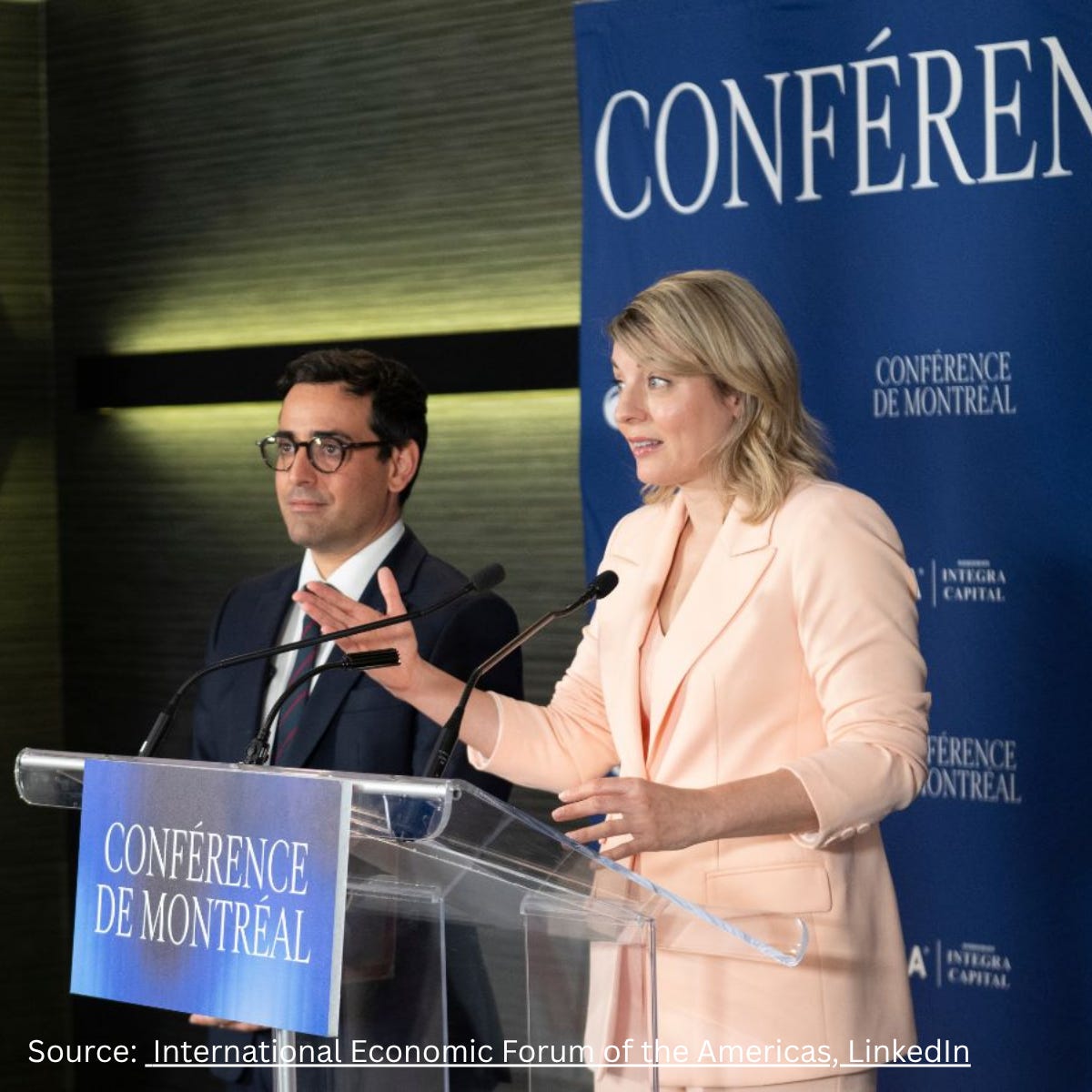
Industry Minister Mélanie Joly put Canada’s industrial strategy and integration with Europe front and centre (link).
--Europe’s Presence--
Europe’s footprint in Montreal was significant. The European Commission sent Stéphane Séjourné to vocalize Brussels’ industrial priorities amid global geopolitical shifts. Erkki Keldo, Estonia’s Minister of Economy and Industry, gave valuable insights on digital power and strategic resilience.
France’s Economy Minister Roland Lescure also led a talk on French-Canadian economic security, competitiveness, and innovation.
Canada and the EU now see their defence-industrial bases as a joint opportunity. Both face production gaps, and both know they need each other to bridge them.
Montreal reinforced what NATO and recent agreements (i.e. SAFE) already signal: Canada and Europe will build together, buy together, and align standards.
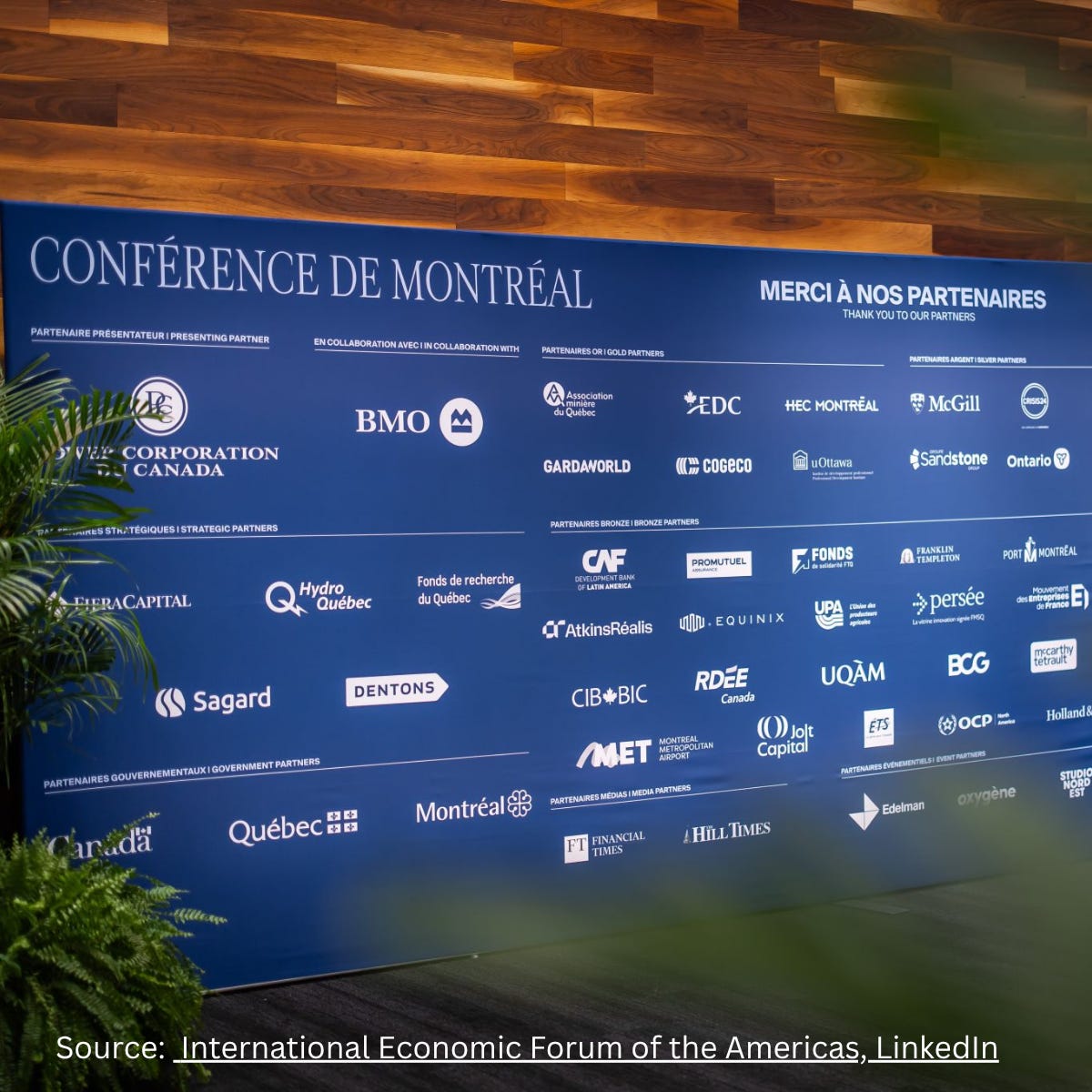
Here’s where SMEs come in. Canada and Europe can’t integrate supply chains through primes alone. SMEs bring the specialized skills and agility that big industry seeks when it looks down its supply chain.
If you lead an SME in defence or critical minerals, this conference confirmed the trajectory. Canada’s industrial base needs depth.
https://www.laconferencedemontreal.com/#/
2) G7
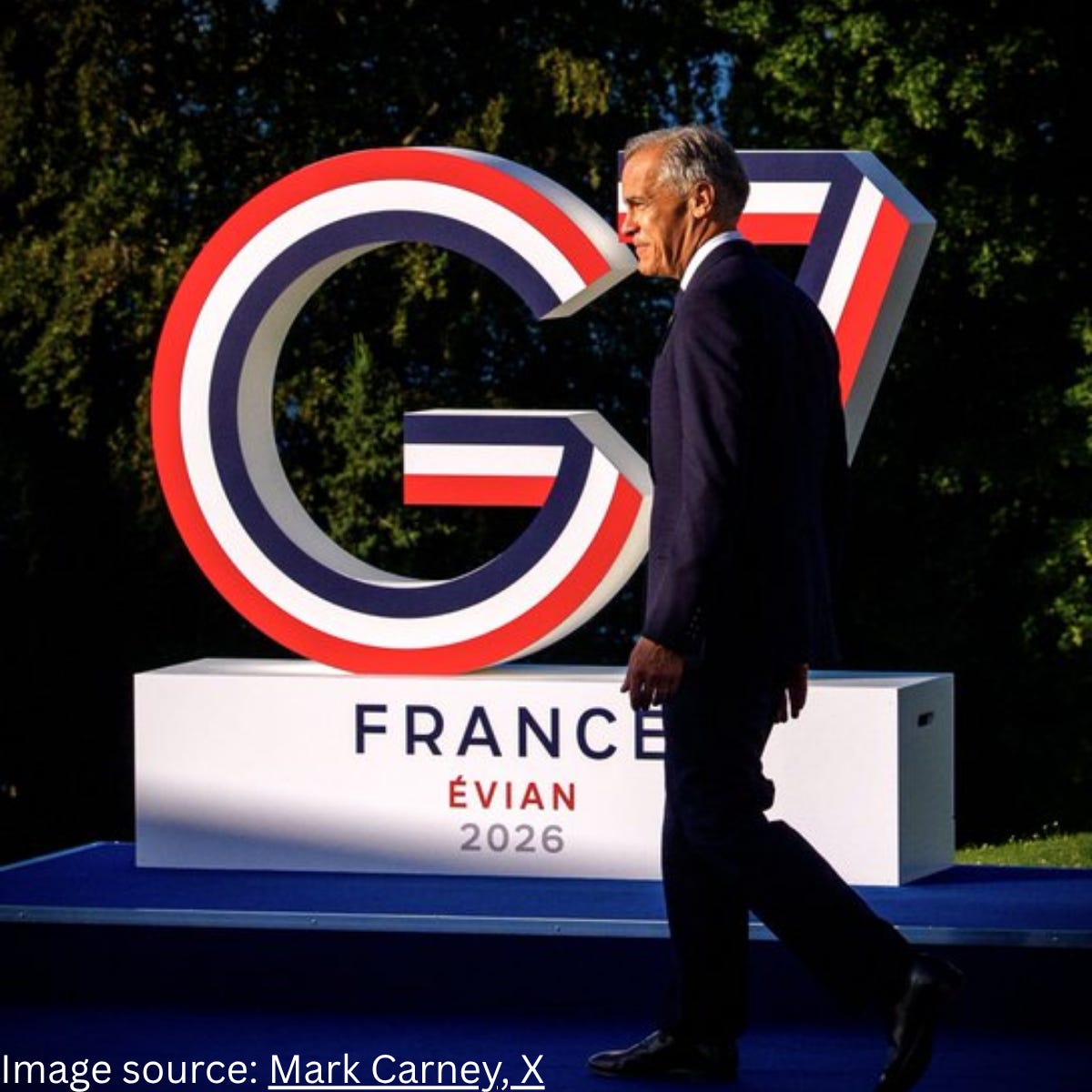
The G7 Summit (Jun. 15-17) wrapped up last week in Évian, France. For the Canadian defence and advanced manufacturing industry, the summit matters more than the headlines let on.
Before you ask. I double checked. It’s not where the bottled water is drawn from.
Still, a key highlight was that we finally saw SAFE’s first Canadian distillation.
News spread fast after the PM announced the $10M contract Montreal’s Marconi Technologies signed with Enamor International to supply the Polish army with Canadian-made radios.
The deal shows how Canada & Europe are shifting their industrial cooperation from a buyer-seller model towards a more integrated supply chain. The signed contract is a great start.
To quote PM Carney: there will be many more.
--Mines & Sensitivities--
Critical minerals were also front and centre.
G7 leaders set a target: cut reliance on any single non-G7 supplier of rare earths and permanent magnets to below 60% by 2030. They announced an IEA-led coordination platform and considered stockpiling, starting with lithium and nickel.
The reason: last year, China’s export curbs on rare earth magnets nearly stalled entire industries, and exposed just how vulnerable Western supply chains are.
No G7 economy can afford to let one supplier control inputs for everything. Canada has the reserves. Now we need to build domestic refining and magnet manufacturing.
The summit produced considerable steps forward.
Here are 4:
MOU between Sio Silica, RCT Solutions (Germany) and NanoXSolar (United States) to collaborate on Sio Silica’s high-purity silica project in Manitoba;
MOU between KAP Minerals (Canada) and Hanwa Co. Ltd. (Japan) to develop a critical minerals processing facility in Kapuskasing, Ontario;
$95M strategic equity investment by Eni (Italy) into Nouveau Monde Graphite’s (Canada) Matawinie Mine in Québec (accounting for 10% of the mine’s planned output).
13 new partnerships with 8+ countries through the Critical Minerals Resilience and Production Alliance
PM Announcement on Critical Minerals
Amid the (now resolved?) drama in Iran and energy sensitivities, the G7 also recognized Canada’s potential as a global energy supplier.
As Europe seeks to diversify energy imports, Canada can (and is) position itself as a pristine critical-resource partner in global supply chains.
--AI Linkage--
AI was on the agenda too. Leaders discussed accountability and misinformation, but here’s the link: AI hardware relies on the same critical minerals. Chips need rare earths. Data centres need copper as well as other materials we don’t process enough at home.
Canada is one of the few countries in the world with a domestic AI powerhouse.
If Canada wants to preserve its seat at the AI table, we need to develop our mineral processing base. Sovereign AI and sovereign minerals are the same fight.
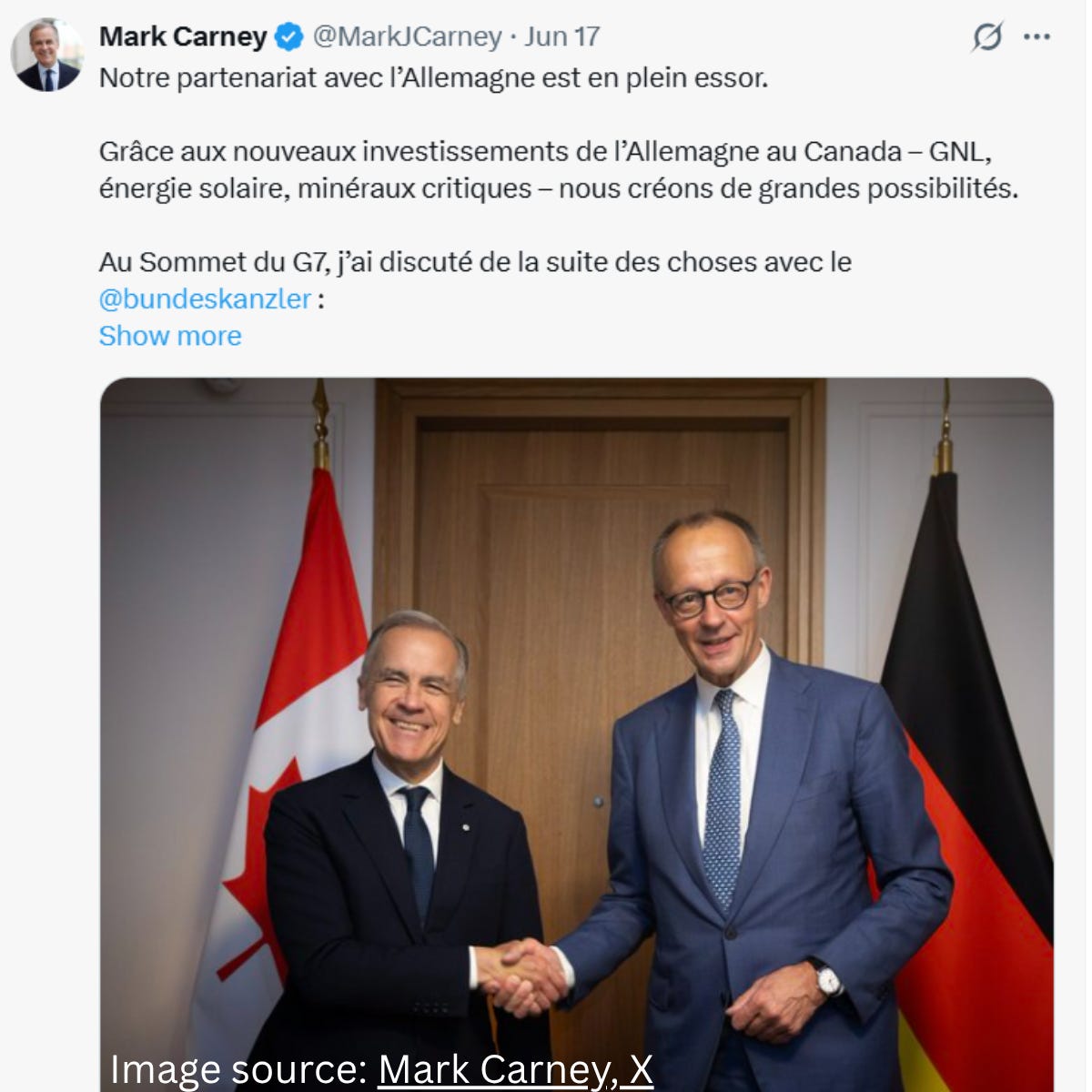
Canada sees the link. Conversations at the G7 built on prior agreements & removed blockages in these areas. For the most recent, see the Canada-France GSOIA, or the less mediatized Canada-German one.
P.S. 1,348 of you are shaping transatlantic relations with www.canadaxeurope.com.
Thanks for being a part of it!
Thanks for a great roundup of events!