


Canada is about to make the largest military procurement decision since the Canadian Surface Combatant (CSC) frigate turned destroyer program in 2019. And based on my previous front-row-seat experience, and the current geopolitical context, it’s not enough to simply ask the bidders to identify Canadian content and offsets.
Canada should be out negotiating more than hardware and global supply-chain integration (or another auto factory).
Canada should buy a seat at the table.
Buy a Submarine Company.
But first, let’s lay out a few of the facts.
Canada is ordering up to 12 conventionally powered submarines in a program worth anywhere from $60-100B over its lifecycle.
Two bidders have been shortlisted: Germany’s ThyssenKrupp Marine Systems (TKMS) - offering the Type 212CD developed jointly with Norway, and South Korea’s Hanwha Ocean, pitching its KSS-III Batch-II.
The Defence Investment Agency (DIA) is running the process and a final decision is expected later this year.
Ottawa already sent both bids back. Unsatisfied with the industrial benefits on offer, the DIA granted both bidders a 20-day extension, ending April 29, to enrich what they’re bringing to Canada beyond the hardware.
The government knows this isn’t just a submarine purchase. It’s a sovereignty play.
So let’s follow that logic to its conclusion.
![[background image] image of a welcoming office environment (for a travel tech)](https://substackcdn.com/image/fetch/$s_!8Wty!,f_auto,q_auto:good,fl_progressive:steep/https%3A%2F%2Fsubstack-post-media.s3.amazonaws.com%2Fpublic%2Fimages%2F507c4ae0-049b-46b8-90c0-36c8c9bb9520_656x552.png "[background image] image of a welcoming office environment (for a travel tech)")
Source: TKMS 212CD

The Hardware Trap
Canada has been here before. The Victoria-class submarines were acquired second-hand from the UK in the late 90s. They were politically expedient and budget-friendly on paper. In practice: delays, breakdowns, a fatal fire, and persistent capability gaps. Buying someone else’s hardware means buying someone else’s problems, supply chains, and production calendar.
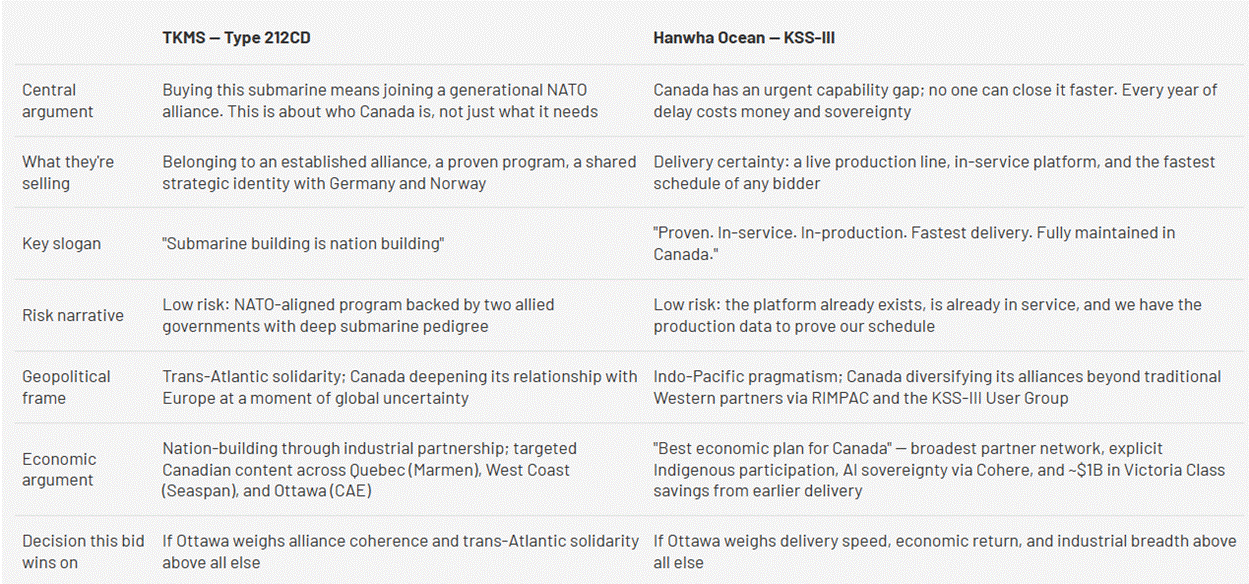
Both TKMS and Hanwha understand this is a political procurement as much as a military one. TKMS is packaging its bid with investments in Canada’s critical minerals, AI, and battery sectors. And pitching Arctic capability as well as cooperation with Germany and Norway.
Hanwha has set up a dedicated Canadian subsidiary, Hanwha Defence Canada, in Ottawa and is promising 22,500 jobs annually and $60B in economic benefits through 2044. Earlier production and cooperation with the Indo-Pacific
Both are offering Canada a piece of the industrial action, but structuring it as a sweetener on top of a hardware sale.
What Owning Capability Actually Looks Like
Countries that make submarines don’t just have submarines. Germany’s TKMS, France’s Naval Group, Sweden’s Saab Kockums. These aren’t just shipyards: they set export terms, they own the IP, and they negotiate from strength.
Canada is preparing to spend tens of billions acquiring submarines designed, built, and ultimately controlled by foreign firms - dependent on those firms for sustainment, upgrades, and capability evolution for the next four decades.
In fact, Canada is probably buying more submarines than either Korea or Germany are ordering for their own use. Canada doesn’t want to get caught in the Canadianization trap - but remaining beholden to foreign firms when you are ordering more units than they can bother ordering from themselves doesn’t sound like value for money.
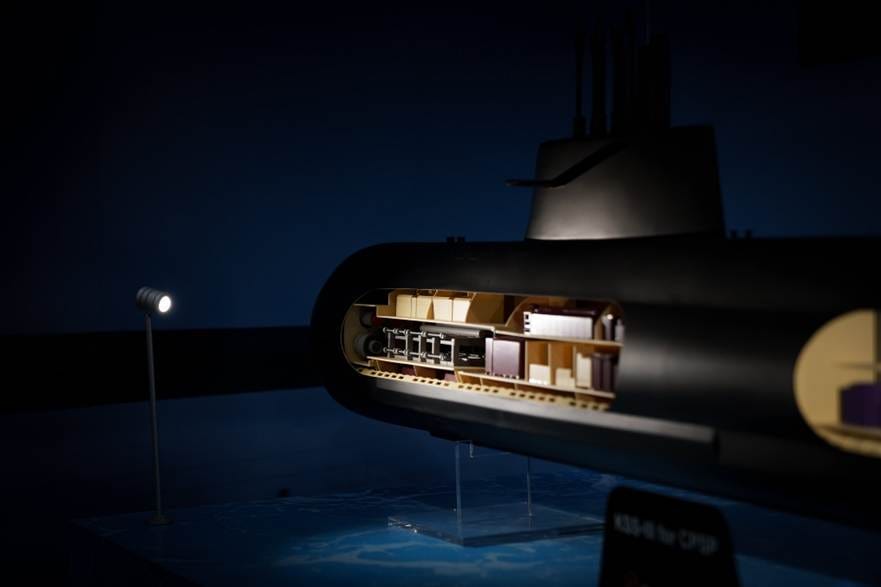
Source: Show Floor. Cansec 2025. Ottawa. May 28, 2025.
The DIA’s mandate explicitly calls for sovereign capabilities. The Defence Industrial Strategy targets growing Canadian defence industry revenues by 240% over a decade and raising the share of defence acquisitions going to Canadian firms to 70%. These are not modest ambitions.
But you cannot achieve industrial sovereignty by purchasing a foreign product with local content requirements attached. You achieve it by owning a meaningful stake in the enterprise itself.
Enter the Canada Strong Fund
On April 27, 2026, Prime Minister Carney announced the Canada Strong Fund - Canada’s first national sovereign wealth fund, seeded with $25B over 3 yrs. Explicitly designed to invest in major strategic Canadian industrial projects alongside private capital, and to build long-term national wealth.
A minority equity stake in Hanwha Ocean or TKMS - negotiated as a condition of the CPSP contract award - would be exactly the kind of strategic, returns-generating investment the Canada Strong Fund was designed for.
So would a Canadian co-ownership structure in a domestic submarine sustainment and production entity, seeded by the winning bidder and capitalised through the Fund.
This isn’t speculative. Norway (TKMS’s partner on the Type 212CD) built its defence industrial base through exactly this kind of strategic co-investment over decades. It’s how you go from being a customer to being a stakeholder.
European Precedents
The model has other European precedents. Both Thales and Airbus were built on the principle that strategic industrial capability is too important to leave entirely to private markets.
The French state holds a direct equity stake in Thales (currently 26%), giving Paris enduring influence over a company that produces everything from naval combat systems to satellite communications.
Airbus, meanwhile, was deliberately constructed as a multi-government industrial project: France, Germany, and Spain retain stakes precisely because aerospace and defence capability is understood as a sovereign asset, not just a commercial one. And the UK holds a £1 veto share in BAE (control without ownership).
The logic in both cases was the same: governments that fund the demand (through procurement contracts) should also capture a share of the industrial value created.
Canada is about to become one of the world’s largest submarine customers. The Defence Investment Agency and the Canada Strong Fund together provide exactly the instruments France and Germany used: public capital with a mandate to build long-term industrial capacity.
Norway didn’t just buy submarines from TKMS, it built itself into the programme. The Norwegian state owns 50.004% of Kongsberg D & A, which co-developed the Type 212CD alongside TKMS and a 50% stake in the joint venture kta Naval Systems - the entity responsible for the combat systems on every 212CD submarine built.
That government-to-government agreement, signed in 2017, covered joint development, procurement, operation, and maintenance - not just a purchase order.
The result: Norway is co-owner of the IP, earns revenue on every system delivered (including to the German Navy), and retains sovereign control over the most sensitive technology in its own fleet. Canada is being offered the same submarine.
The question is whether it negotiates like a customer or like Norway. And whether Ottawa is willing to think like Paris, London or Madrid.
The Ask
The DIA is a new institution built to move faster and think bigger. Its CEO, Doug Guzman, brings a career at RBC: someone who understands deal structures, equity, and long-term capital. This is the moment to use it.
Before Canada signs the Canadian Patrol Submarine Project contract, there should be a serious conversation about whether the deal can include:
• An equity stake in the winning bidder’s Canadian operations, held through the Canada Strong Fund
• A technology transfer and IP co-ownership arrangement giving Canada the sovereign ability to sustain and evolve the fleet independently
• Or a Canadian production entity (majority Canadian-owned) that takes on progressively more of the build, sustainment, and ultimately export work over the life of the program.
Both TKMS and Hanwha have already signalled a willingness to invest heavily in Canadian capacity. The DIA should take that signal and raise.
The Bigger Picture: Don’t just buy a submarine. Buy into the industry that builds them.
Canada is being asked to make a generational decision about its place in the global defence industrial order. The world is fragmenting. Supply chains are being repatriated. AUKUS has already demonstrated that technology transfer and industrial partnership, and not just hardware sales, are the new currency of strategic relationships.
Canada has the procurement leverage, a brand-new sovereign fund, a new defence investment agency, and a government explicitly committed to industrial sovereignty.
It has never had a better moment to stop being a buyer and start being an owner and leave behind an automotive addiction.
Don’t just buy a submarine. Buy into the industry that builds them.
P.S. 1,210 of you are shaping Canada–Europe relations with www.canadaxeurope.com. Thanks for being a part of it!
"A minority equity stake in Hanwha Ocean or TKMS - negotiated as a condition of the CPSP contract award..." - This ia precisely the actual sovereignty play not just being a consumer buying milk every other week from the grocery store.
The "auto factory addiction" has me in stitches, if that's all the top folks in procurement want to get out of a major defence procurement deal, then maybe some actual defense heads need to be at DIA not just private sector businessmen.
I believe the 2nd point in your asks (technology transfer and independant sustainment and upgrading of the submarines) is part of the program already.
It might not be full co-IP ownership, perhaps just and end-user license that allows for any and all work on our own submarines. But being able to fully sustain the submarines in Canada and upgrade/refit them our selves with whatever kit we chose is definitely part of it.