


--We’re sharing a deep dive from our notes with you from the recent Canadian Space Agency (CSA) announcement. This should be treated for information-only purposes.--
Now that the disclaimer is out of the way, let’s get started on the deep dive for this giant generational investment.
In Nov 2025, the Government of Canada (Canada) announced a historic investment in European Space Agency (ESA) programming.
It was finalised at the last Ministerial Council meeting of the ESA, held on Nov 27-28th, where CSA President Lisa Campbell announced that Canada will commit around €407M ($664M) to key ESA programs.
Canada’s $664M investment in the European Space Agency is the most significant investment Canada has made since partnering with the ESA, supporting both civilian and defence R&D for Canadian space tech.
It is expected to create hundreds of jobs in Canada and generate significant ROI. Canadian-ESA investments have traditionally seen an average return ratio of 3:1 - every dollar granted produced a 3x return.
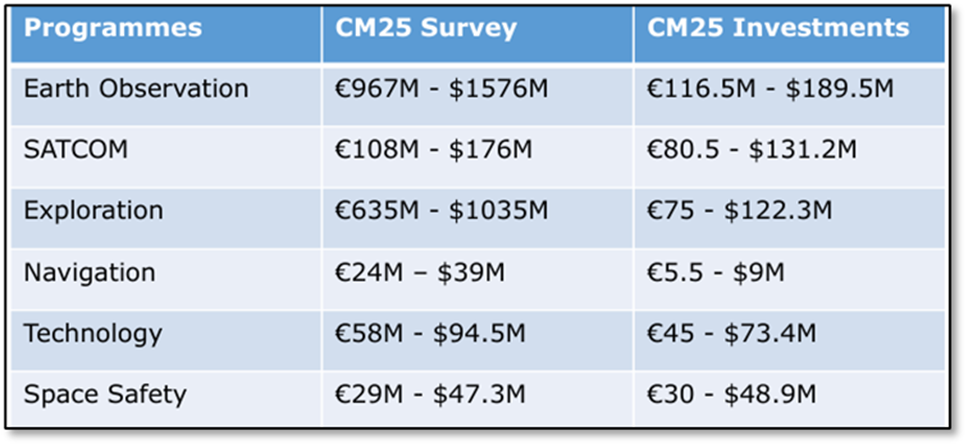
The funding will go to critical ESA Program Areas ranging from Satellite Communications and Earth Observations, to Space Exploration, Space Safety, and Navigation and Technology Development. The programs were selected following consultations with Canadian firms in the space sector.
To quote Minister of Industry Mélanie Joly, it will “open doors to international collaboration, and strengthen our collective security.”
What’s in it for Canadian firms?
Aside from investing dollars in international projects, the move is designed to give tangible benefits to the Canadian industry. Money will be allocated to key fields determined from consultation with the Canadian space sector. Enhanced Canadian access to the European market means that firms will be positioned to compete for high-value contracts and engage with European leaders in the sector. Partnerships are a two-way street.
For the defence industry: With its Defence Industrial Strategy in mind, Canada will invest in ESA programs aligning with its strategic objectives. This means that over the next 3 years, Canada will focus on programs to enhance its capacity to meet its dual-use requirements.
ESA Overview
The main appeal of the ESA is scale: with 31 participating states, it is 2nd only to NASA in terms of annual funding (over $10B) and is Canada’s second biggest partner space agency.
Canada and the ESA began their partnership in 1979, and Canada holds a special position as the agency’s only non-European cooperating state.
Every 3 years, the ESA holds Ministerial Council meetings (the last one in Nov 2025), during which members confirm investments in optional programs. The CSA now has a key role in diversifying and strategically growing its international partnerships in line with the Canadian government.
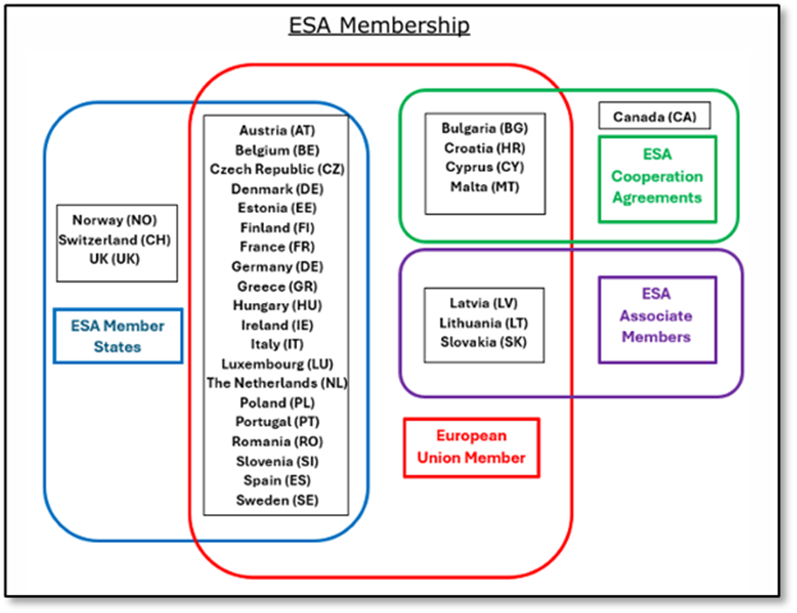
For Canadian multilateralism, partnering with the ESA extends to the space industry by granting access to European contracts and growing transatlantic relationships.
For businesses, this means more commercialisation opportunities and a new arena to trial Canadian tech for future sales.
Partnering on complex missions with the ESA means sharing risks and burdens among more parties, while the overall reward to Canada is growth.
ESA and ReArm Europe
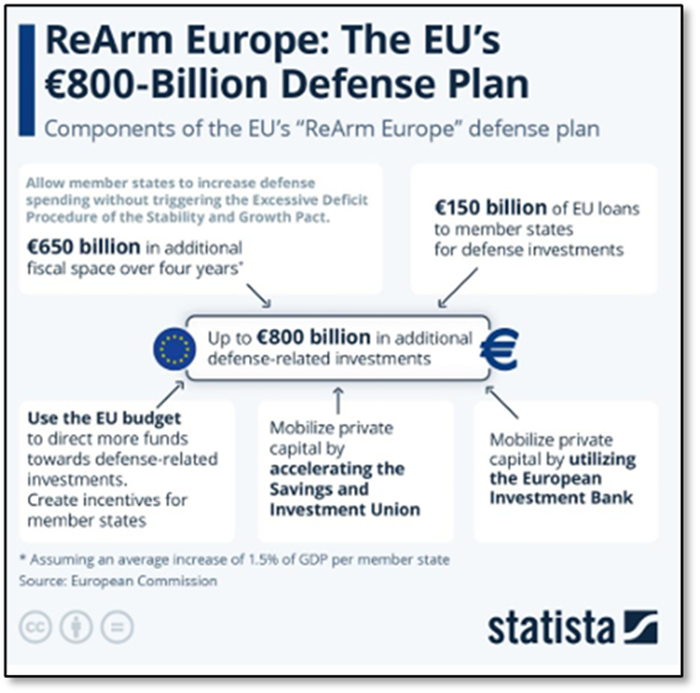
On defence, engaging the ESA means taking advantage of the bridges being built between the European space and defence sectors. The ESA has been focused on supporting Europe’s Readiness 2030 plan (formerly ReArm Europe), which aims to mobilise €800B in defence spending over the next 4 years. The ESA plans to contribute to this mobilisation by bringing the space and defence sectors closer together, increasing its dual-use and security-related initiatives, and committing to defence-related programs if mandated to do so by its member states.
In short, the ESA has a key role in space and the defence of space.
ESA Investment
The ESA’s funding model follows a “pay to play” scheme. The money Canada invests in ESA programs is returned (excluding overhead) as “geo-return” contracts to Canadian firms in the space sector.
Funding received by the ESA is directed between two types of activities: mandatory and optional.
Mandatory: operational expenses for labs, studies, shared technical investments, information systems, cybersecurity, administration, and training.
Optional: funding at the discretion of participating countries to cover Earth observation, telecommunications, satellite navigation, space exploration, space safety, and space transportation.
When Canada announced its investment of $664.6M into the ESA, the amount 10x (an out-of-this-world increase).
The financial weight given to each ESA program area matched the priorities reflected by Canada’s space industry in the CM25 survey.
What’s On the Table: ESA Activities
The ESA’s program areas cover a wide range of sub-programs that will benefit from Canadian investment:
Earth Observation (EO) programs are designed to provide data related to climate, natural resources, and Earth’s environment.
Human and robotic exploration, the European Exploration Envelope Programme (E3P) is ESA’s flagship exploration program focusing on the Moon, Mars, and low Earth orbit.
Connectivity and Secure Communications (CSC) initiative is designed to implement high-performing satellite communications systems for government and commercial use.
ESA’s Navigation programmes, as well as its Space Safety Programme, monitor for hazards, including space debris and asteroids.
The General Support Technology Programme (GSTP) will provide funds for services, technology, and products in space.
Finally, companies should note the ESA’s ACCESS programme, designed to provide businesses (small and mature) with funding, technical support, and networking opportunities to promote products and services.
What’s next: Opportunities & Webinars
For space firms that are interested in pursuing one of the avenues opened by the ESA announcement, there are a couple of items to take note of.
The ESA:
1) opened its System for Tendering and Registration (esa-star) allowing companies to register as contractors, browse procurement/tender opportunities, and bid for ESA contracts or projects.
2) opened its Open Space Innovation Platform (OSIP) for those interested in sharing proposals for open innovation campaigns and channels.
3) the CSA and the ESA have scheduled webinars starting in early 2026 on topics including applying for funding and proposal writing, deep-dives into the each of the ESA’s major program areas, and information on intellectual property.
That concludes your CSA x ESA deep dive. If you’re in a space or space-related industry, feel free to post any corrections or omissions in the comments!
PS. Canada recently launched its own funding for:
1. Advanced Technologies
2. Small Business Stream (≤50 employees)
3. Next Wave Technologies
And we covered the Lunar Utility Rover Complementary Technology Development and Canada’s next-generation satellite system ground segment – concept study in our last missive.
PPS. The folks at Build Canada eloquently laid out the case for Canadian investment in Space.
PPPS. 1,049 people now follow CanadaXEurope on LinkedIn and Substack. Thanks for being a part of it!
This recap is much appreciated! Canada and the ESA can only benefit from this reciprocal and fair agreement and help diversify Canada’s interests abroad.