


Canada Just Unlocked Access to France’s Defence Market. Here’s What That Means.
“We are more than allies…we are part of the same family. And in a more dangerous and more divided world, this relationship is more important than ever.”
PM Mark Carney spoke in Paris on June 12, two days before the G7 summit in Évian, less than a year after making France his first international visit.

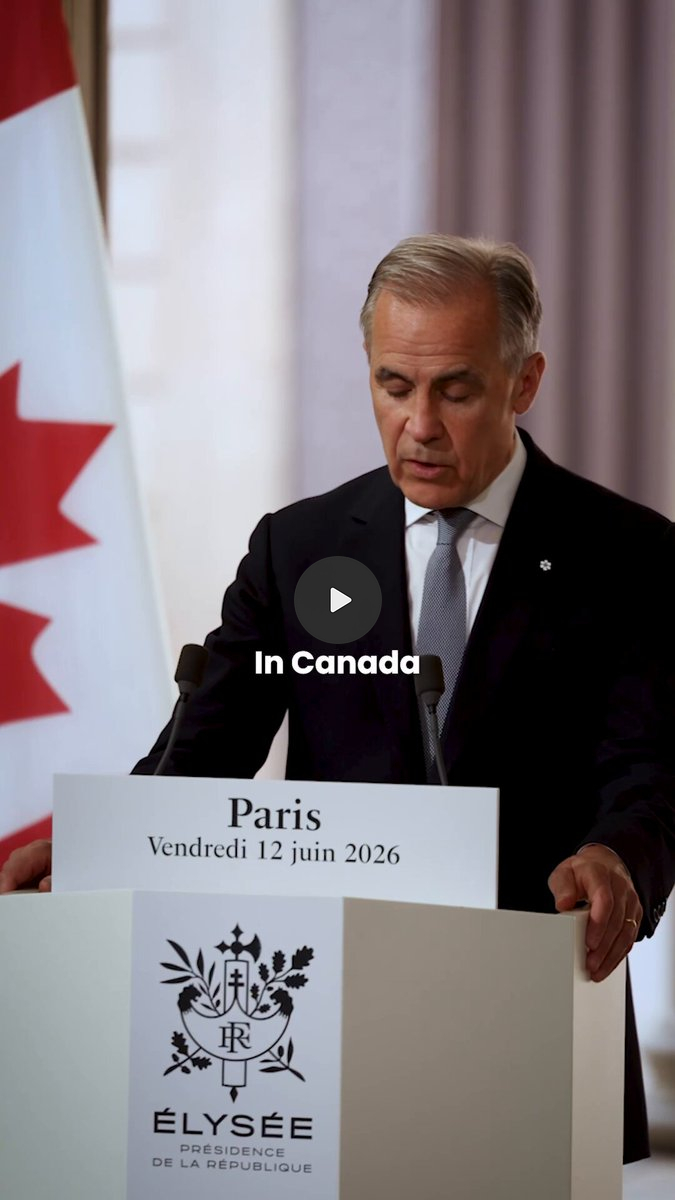
The key outcome for Canada’s defence industry is signing a General Security of Information Agreement (GSOIA) with France.
This on the eve of Europe’s largest defence conference, Eurosatory, starting Monday in Paris (alongside the G7)
and Canada’s largest ever participation in it.
Canada's record showing at Eurosatory

One week from Eurosatory, where Europe’s largest European defence show meets one of Canada’s largest trade delegations.
Negotiated by Public Services and Procurement Canada, in collaboration with Global Affairs Canada and the Department of National Defence, the agreement establishes a secure framework for exchanging classified information.
As Carney put it, it creates “the ability to exchange classified information…our space, defence and aerospace sectors will have better opportunities to bid on contracts, form R&D partnerships, and strengthen commercial ties.”
Previously, Canadian firms pursuing French defence contracts or joint R&D faced a structural barrier; no mechanism existed to share required classified information. That barrier is now gone.
The sectors covered are worth noting: aerospace and space systems, cybersecurity and secure communications, AI and advanced data systems, maritime and underwater technologies, and dual-use defence platforms. These sit at the core of Canadian industry capability, where concentration is high, and growth is actively pursued.
President Macron described the broader relationship as strategic, noting complementarity between the defence industries and the need to move “from political convergence to concrete, lasting industrial cooperation.”
The France GSOIA is Canada’s seventh such agreement since December 2024, following Ukraine, Poland, Spain, Portugal, and the European Space Agency.
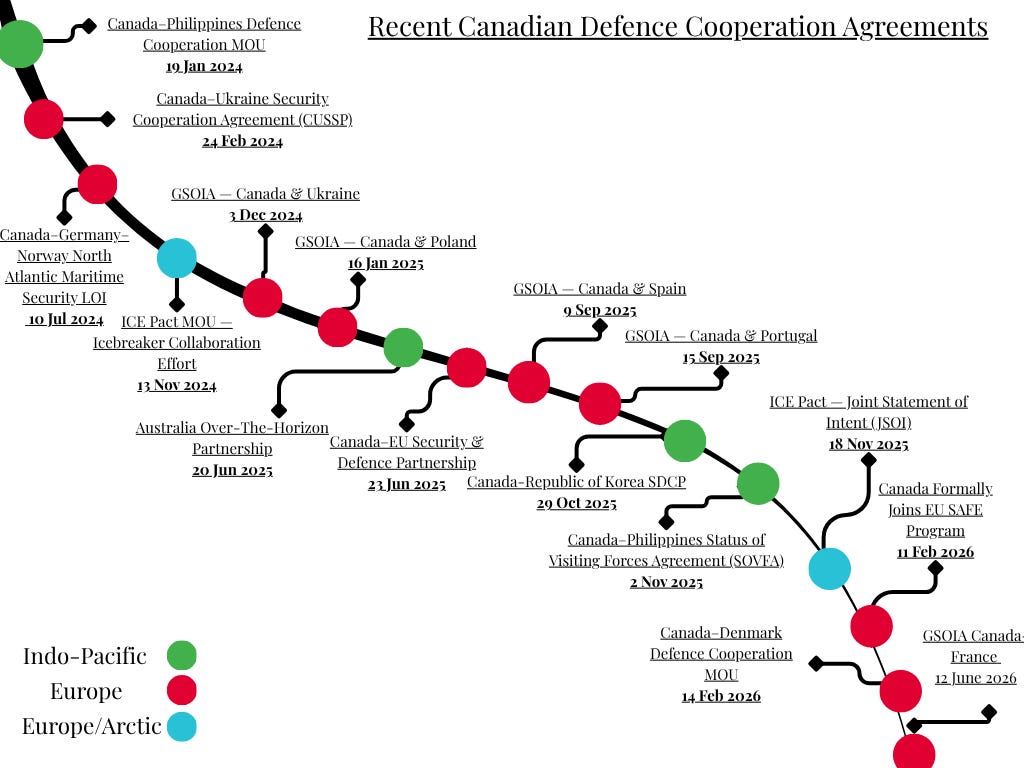
Alongside other agreements - EU-Canada Security and Defence Partnership (June 2025), Canada’s accession to the EU’s SAFE defence procurement instrument (February 2026), the ICE Pact icebreaker industrial partnership with Finland and the US, a tech partnership with Australia on the Arctic Over-the-Horizon Radar system, bilateral defence cooperation MOUs across Europe and the Indo-Pacific, and a Ukraine security cooperation agreement - Canada has concluded more than 20 defence and security agreements since 2024.
Canada is systematically building treaty, industrial security, and cooperation infrastructure to support allied engagement.
The GSOIA also sets the stage for deeper collaboration in areas both leaders identified as strategic priorities: AI, quantum, critical minerals, and energy.
Carney noted that Canada and France are among only four countries globally with large language model capabilities, framing the AI partnership as an opportunity.
For Canadian defence firms tracking European market access, this is a meaningful development. The harder work - identifying opportunities, building industrial relationships, navigating French procurement - remains ahead.
But now the door is open, and for the first time in a long time, Canada is opening many doors at once.
Over to industry to turn diplomacy into trade.
P.S. 1,305 of you are shaping Canada-Europe relations with www.canadaxeurope.com. Thanks for being a part of it!
https://www.sophiainitiative.ai/p/the-french-connection?r=1pgr4n&utm_campaign=post&utm_medium=web
An excellent article! Canadian industry and businesses must take advantage of these open diplomatic doors.